Need help? National Domestic Violence Hotline 1-800-799-7233, or text START to 88788. In an emergency, call 911.Hotline 1-800-799-7233, or text START to 88788. Emergency: 911.

Understanding Coercive Control

29Dec 2026TuesdayPlanned

Episode 6: Whose Problem Is It?

Gender, LGBTQ+ Survivors and Coercive Control

Is coercive control a gendered pattern? National surveys, agency data and court records give different answers, and each is measuring something real.

Episode
6 of 10
Running time
17:42
Sources
29, listed below
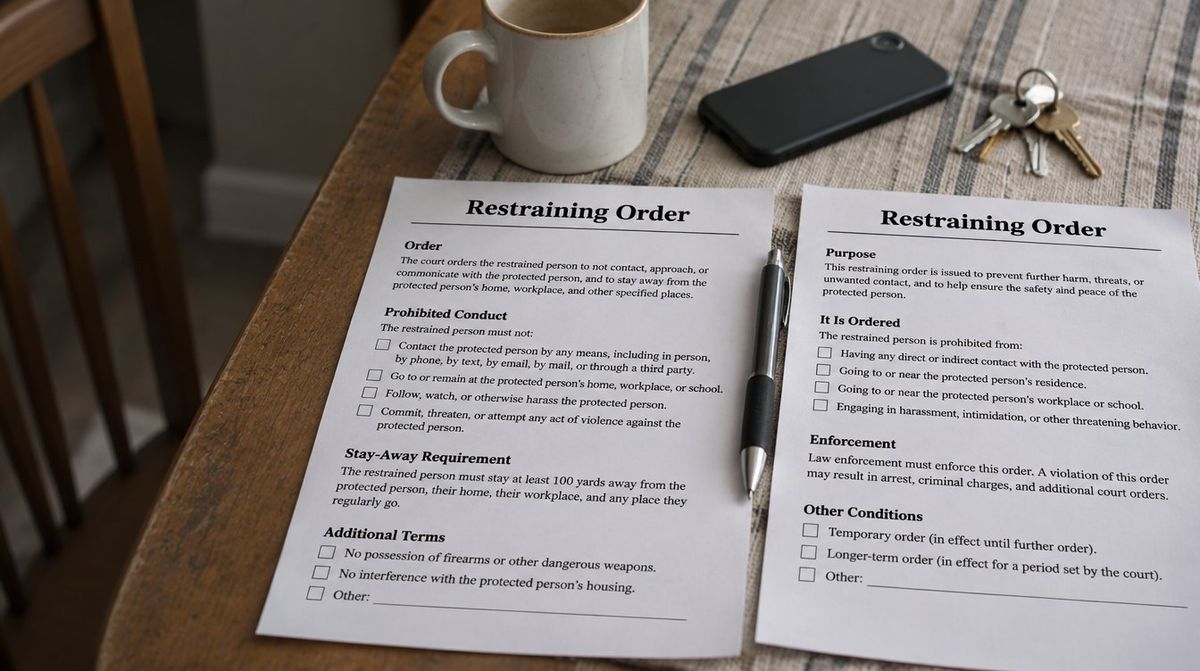
A printed restraining order on a table with a pen and a coffee mug
Coming Dec 29The video will play here. Nothing loads from YouTube until you press play. The picture is an AI-generated illustration, not from the records.

What this episode covers

This episode sets out what the evidence shows for women, men and LGBTQ+ people, what federal and state law require, and what three court opinions say about services, proof and who files first.

Law checked

13Nov 2026

Nov 13, 2026, federal and state. Federal: 34 U.S.C. § 12291. State: California, Connecticut and New Jersey only. Laws change; check the current status in your state. Federal grant conditions added in 2025 were set aside by a federal court on Sept. 29, 2026 (Rhode Island Coalition Against Domestic Violence v. Blanche, D.R.I. No. 25-cv-279); check for an appeal. California's coercive control examples expand on Jan 1, 2027 (AB 2534).

About the cases

All cases come from court opinions in the public record. We do not name the parties in narration; case names appear only as the courts captioned them. Case 3 was decided before California added coercive control to its Family Code; calling it coercive control is our reading. UK studies are comparison points, not US estimates. The facts told in the cold open and in Case 2 come from the plaintiffs' own accounts.

Updates since recording

None so far.

Sources, in on-air order

29 sources. Each has its own link you can copy, for example episode-6.html#S-124.

  1. S-055

    Kudon et al., NISVS 2023/2024 Intimate Partner Violence Data Brief, CDC (February 2026), Tables 7 and 9

    Government survey · United States

  2. S-103

    Chen et al., NISVS 2016/2017 Report on Victimization by Sexual Identity, CDC (October 2023), Tables 27 and 30

    Government survey · United States

  3. S-104

    Johnson, Conflict and Control: Gender Symmetry and Asymmetry in Domestic Violence, Violence Against Women 12(11) (2006)

    Peer-reviewed study · United States

  4. S-124

    Stark & Hester, Coercive Control: Update and Review, Violence Against Women 25(1) (2019)

    Peer-reviewed study · United States

  5. S-059

    Myhill, Measuring Coercive Control: What Can We Learn From National Population Surveys?, Violence Against Women 21(3) (2015)

    Peer-reviewed study · United Kingdom

  6. S-057

    Dutton, Goodman & Schmidt, Development and Validation of a Coercive Control Measure for Intimate Partner Violence: Final Technical Report (NIJ, 2005)

    Government-funded research report · United States

  7. S-108

    Bates, Graham-Kevan & Archer, Testing predictions from the male control theory of men's partner violence, Aggressive Behavior 40(1) (2014)

    Peer-reviewed study · United Kingdom

  8. S-061

    Office for National Statistics (UK), Developing a measure of controlling or coercive behaviour (Apr. 18, 2019)

    Official statistics · United Kingdom

  9. S-110

    Woulfe & Goodman, Identity Abuse as a Tactic of Violence in LGBTQ Communities: Initial Validation of the Identity Abuse Measure, Journal of Interpersonal Violence 36(5-6) (2021; online 2018)

    Peer-reviewed study · United States

  10. S-116

    Washington State Administrative Office of the Courts, DV Manual for Judges (2015), Appendix D, Domestic Violence in Lesbian, Gay, Bisexual, Transgender, and Queer Relationships

    Judicial bench guide · Washington

  11. S-111

    James et al., The Report of the 2015 U.S. Transgender Survey, National Center for Transgender Equality (2016), executive summary

    Survey research by an advocacy organization · United States

  12. S-112

    Hirschel, Buzawa, Pattavina, Faggiani & Reuland, Explaining the Prevalence, Context, and Consequences of Dual Arrest in Intimate Partner Cases, report to the National Institute of Justice (2007), NCJ 218355

    Government-funded research report · United States

  13. S-113

    34 U.S.C. § 12291(a)(12) and (b)(13) (Violence Against Women Act definitions and grant conditions)

    Federal statute · United States

  14. S-114

    Rhode Island Coalition Against Domestic Violence v. Blanche, D.R.I., No. 25-cv-279 (orders of Apr. 17 and Sept. 29, 2026)

    Federal trial court orders · United States

  15. S-100

    Woods v. Horton (2008) 167 Cal.App.4th 658, Cal. Ct. App., 3d Dist., No. C056072 (Oct. 14, 2008)

    Published appellate opinion · California

  16. S-115

    Cal. Penal Code § 13823.15 (Comprehensive Statewide Domestic Violence Program)

    Statute · California

  17. S-101

    J.R. v. N.K., 232 Conn. App. 434 (May 6, 2025), No. AC 46564

    Published appellate opinion · Connecticut

  18. S-123

    McCord v. Smith (2020) 51 Cal.App.5th 358, Cal. Ct. App., 4th Dist., Div. 3, No. G057614

    Published appellate opinion · California

  19. S-007

    California SB 1141 (2020) summary

    Enacted law (act or session law) · California

  20. S-008

    New Jersey A1475 / P.L.2023, c.230

    Enacted law (act or session law) · New Jersey

  21. S-109

    Barlow, Johnson, Walklate & Humphreys, Putting Coercive Control into Practice: Problems and Possibilities, British Journal of Criminology 60(1) (2020)

    Peer-reviewed study · United Kingdom

  22. S-006

    K.L. v. R.H. (Cal. Ct. App. 2021), No. G059109

    Appellate court opinion · California

  23. S-021

    California Penal Code § 836(c)(3) (dominant aggressor definition, quoted in K.L. v. R.H.)

    Statute · California

  24. S-106

    Douglas & Hines, The Helpseeking Experiences of Men Who Sustain Intimate Partner Violence: An Overlooked Population and Implications for Practice, Journal of Family Violence 26(6) (2011)

    Peer-reviewed study · United States

  25. S-063

    US Preventive Services Task Force, Intimate Partner Violence and Caregiver Abuse of Older or Vulnerable Adults: Screening, Final Recommendation Statement (June 24, 2025)

    Independent federal panel recommendation · United States

  26. S-122

    45 C.F.R. § 1370.5 (Family Violence Prevention and Services Act programs, nondiscrimination)

    Federal regulation · United States

  27. S-120

    New York City Anti-Violence Project

    Advocacy organization resource · New York

  28. S-121

    NW Network of Bisexual, Trans, Lesbian & Gay Survivors of Abuse, archive of writing, resources and tools

    Advocacy organization resource · Washington

  29. S-117

    Battered Women's Justice Project, National Defense Center for Criminalized Survivors

    Advocacy organization resource · United States

Background reading for this episode

Read while this episode was researched, and not cited in the video.

  1. S-105

    Johnson, Leone & Xu, Intimate Terrorism and Situational Couple Violence in General Surveys: Ex-Spouses Required, Violence Against Women 20(2): 186-207 (2014)
    Peer-reviewed study · United States

  2. S-107

    Hines & Douglas, A Closer Look at Men Who Sustain Intimate Terrorism by Women, Partner Abuse 1(3): 286-313 (2010)

    Peer-reviewed study · United States

  3. S-118

    Salmon v. Salmon (2022) 85 Cal.App.5th 1047, Cal. Ct. App., 4th Dist., Div. 2, No. E075748

    Published appellate opinion · California

  4. S-119

    Connecticut law check of Nov 13, 2026: OLR bill analysis of Conn. HB 5438 (2026); Conn. Public Act 26-92

    Legislative record · Connecticut